
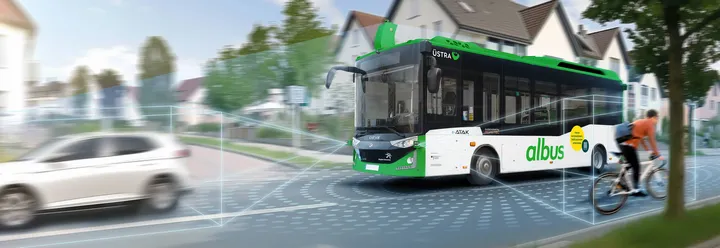
albus – the autonomous bus service in the Hanover region
Autonomous travel with albus: in Burgdorf, we are testing the first self-driving bus service in public transport – a milestone for the mobility transition.
Experts agree: autonomous driving is key to the mobility transition. In the future, autonomous vehicles will help to provide comprehensive local public transport services around the clock – even outside urban areas. In the town of Burgdorf, the Hanover region is now making mobility history – with albus, the first automated public transport bus in trial operation in Germany. albus will continue to operate in Burgdorf in 2026.
Be part of the mobility revolution
Register now as a tester!
How can I come along?
Be part of the mobility revolution – test and rate our automated regular service!
Become a tester now!
Register now and try albus!
This is how albus drives
You can find the current timetable here – all journeys now also go to the southern part of the city.
How can I come along?
Would you like to ride with albus yourself? Be part of the mobility revolution – test and evaluate our automated public transport service! The trial operation has been open to all adults since September 2025. Unfortunately, electric wheelchairs cannot currently be accommodated in the vehicle. We are therefore looking into whether we can redesign the multi-purpose area. To test albus, you must register in advance. You can do this once online via this link with a personalised QR code
or in analogue form on paper in the vehicle. Your registration for the albus trial will remain valid beyond the turn of the year in 2026. Registration for individual journeys is still not required.
BE PART OF THE MOBILITY REVOLUTION
Register now as a tester!
This is how albus drives
In 2026, autonomous operation will be even more closely aligned with real-life regular service. This includes more regular intervals and adjusted travel times. albus usually runs every hour from 8:50 a.m. to 3:50 p.m. on Tuesdays, Wednesdays, Thursdays and Saturdays, as well as every other Monday.
We publish the exact journey times here and on the timetables displayed at the stops on a monthly basis. You can get on and off at all stops along the route.
As this is a trial service, deviations from the schedule or cancellations of individual planned journeys are still possible at any time.
The following journeys cannot be offered (as of 11 March 2026):
7–14 March: albus will be attending the
Mobility Move
trade fair in Berlin. Therefore, no journeys will be offered during this week.
30 March: The 8:50 a.m. journey is cancelled.
31 March: The 8:50 a.m. journey is cancelled.
3–6 April: albus is taking a short Easter break. No journeys will be offered on these days.
albus timetable February und March 2026
Monday*, Tuesday, Wednesday, Thursday, Saturday
| Stops | |||||||
| Burgdorf/Bahnhof | 8:50 | 9:50 | 10:50 | 11:50 | 13:50 a | 14:50 | 15:50 |
| Burgdorf/Wallgartenstraße | 8:52 | 9:52 | 10:52 | 11:52 | 13:52 a | 14:52 | 15:52 |
| Burgdorf/Immenser Straße | 8:56 | 9:56 | 10:56 | 11:56 | 13:56 a | 14:56 | 15:56 |
| Burgdorf/Depenauerweg | 8:58 | 9:58 | 10:58 | 11:58 | 13:58 a | 14:58 | 15:58 |
| Burgdorf/Geibelstraße | 9:00 | 10:00 | 11:00 | 12:00 | 14:00 a | 15:00 | 16:00 |
| Burgdorf/Paradiesweg | 9:02 | 10:02 | 11:02 | 12:02 | 14:02 a | 15:02 | 16:02 |
| Burgdorf/Stadtfriedhof | 9:04 | 10:04 | 11:04 | 12:04 | 14:04 a | 15:04 | 16:04 |
| Burgdorf/Schulzentrum | 9:08 | 10:08 | 11:08 | 12:08 | 14:08 a | 15:08 | 16:08 |
| Burgdorf/Scharlemannstraße | 9:10 | 10:10 | 11:10 | 12:10 | 14:10 a | 15:10 | 16:10 |
| Burgdorf/Rubensplatz | 9:13 | 10:13 | 11:13 | 12:13 | 14:13 a | 15:13 | 16:13 |
| Burgdorf/Immenser Straße | 9:16 | 10:16 | 11:16 | 12:16 | 14:16 a | 15:16 | 16:16 |
| Burgdorf/Kleiner Brückendamm | 9:19 | 10:19 | 11:19 | 12:19 | 14:19 a | 15:19 | 16:19 |
| Burgdorf/Wallgartenstraße | 9:22 | 10:22 | 11:22 | 12:22 | 14:22 a | 15:22 | 16:22 |
| Burgdorf/Bahnhof | 9:25 | 10:25 | 11:25 | 12:25 | 14.25 a | 15:25 | 16:25 |
Out and about in Burgdorf
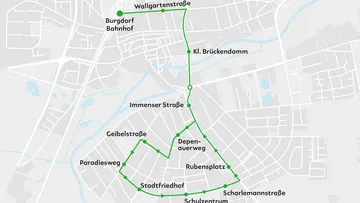
The trial operation will take place independently of regular service along a route based on bus line 906 in Burgdorf.
The automated route runs from the train station via Gartenstraße, Vor dem Celler Tor, Kleiner Brückendamm, the Schwarzer-Herzog roundabout in the southern part of the city, Geibelstraße, Niedersachsenring, Berliner Ring, Immenser Landstraße and Immenser Straße, and back to the train station.
The vehicle travels around six kilometres through the city – in regular mixed traffic at speeds of up to 40 km/h. The electric bus serves stops, crosses traffic light junctions and negotiates urban challenges such as roundabouts and pedestrian crossings completely autonomously.
Safe thanks to sensors
The bus used is a KARSAN autonomous e-ATAK model from the manufacturer KARSAN, which has been equipped with sensors, hardware and software for fully automated operation by project partner ADASTEC. It offers 22 seats and a range of up to 300 kilometres with a length of eight metres. The bus is equipped with modern sensors (LiDAR, radar and infrared) that enable precise positioning and environmental perception all around. The vehicle detects changes on the route, predicts behaviour in real time and reacts in the interests of safe and smooth driving. During the test phase, trained personnel are also on board who can intervene in the control system at any time.
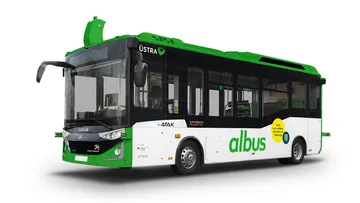
Our project partner ADASTEC presents the details of the bus here.
Researching
What impact does the use of automated transport have on other road users? Are there any particular challenges? Do these change over time? Scientific studies are designed to answer these and other questions and support the introduction of automated transport by analysing factors such as acceptance, environmental and traffic impacts, and legal frameworks. You can easily take part yourself!
An initial online survey was conducted before the start of the trial operation until the end of August 2025. The survey gathered insights into the public's acceptance of automated driving in public transport before the start of the trial operation. We received feedback from more than 1,300 people. After the test operation has been completed, a second survey will be conducted to record and evaluate acceptance after the test operation and any changes in acceptance.
This will allow the vehicle, driving behaviour, accessibility and driving experience to be evaluated. This feedback will be directly incorporated into further development and will be scientifically monitored. The results will be published here after the project has been completed.
We would like to express our sincere thanks for the extensive participation!
The project is being funded by the German Federal Ministry of Transport (BMV) with around €3.7 million until mid-2027 and is being continuously developed on the basis of a resolution passed by the German Bundestag.
Any further questions regarding the albus project?
Then you've come to the right place!